Tumult 3.0.4
This release tests disaster recovery (DR) for real. A DR run measures how long the target was down and how much data it lost, and a run that does not come back fails. A DR exercise that people run by hand is now a full record, with a plan, files, sign-offs and an audit trail. One page and three reports show the DR tests of each target, with the evidence an auditor asks for.
The lake moves from schema v21 to v26 the first time 3.0.4 opens it. Some runs and scores come out differently on purpose, so read Behaviour that changed before you upgrade. The disaster recovery guide shows how to write and read a DR test.
What you will notice
- The RTO starts at the outage. The clock runs from the first probe read that fails after the method starts to the first read that passes again. A run that does not come back breaches its RTO. A fault that no probe saw proves nothing: its RTO is inconclusive, “no outage observed”.
- The test sets its recovery window. A
recoveryblock says how long a run watches for recovery and how often it reads the probes.tumult run --recovery-windowsets the window for one run. - The RPO is measured. A step writes markers before the fault, and a probe reads them back after the recovery and prints the seconds of data lost. An
rpoobjective judges that number. - Real DR steps for PostgreSQL. The plugin can back up, restore, stop the primary and promote a standby. The demo fails a Postgres pair over and restores a backup for real, and
make demo-checkproves both. - Robustness verdicts. A soak judges how far its p95 and error rate drift, and a spike how fast the p95 comes back.
- Manual exercises are first class. A restore test or a failover drill gets a plan with a due date, the RTO and RPO planned and actual, people, steps, actions with owners, files kept by their SHA-256, sign-offs by other users and an audit trail you can verify. Use the Manual page,
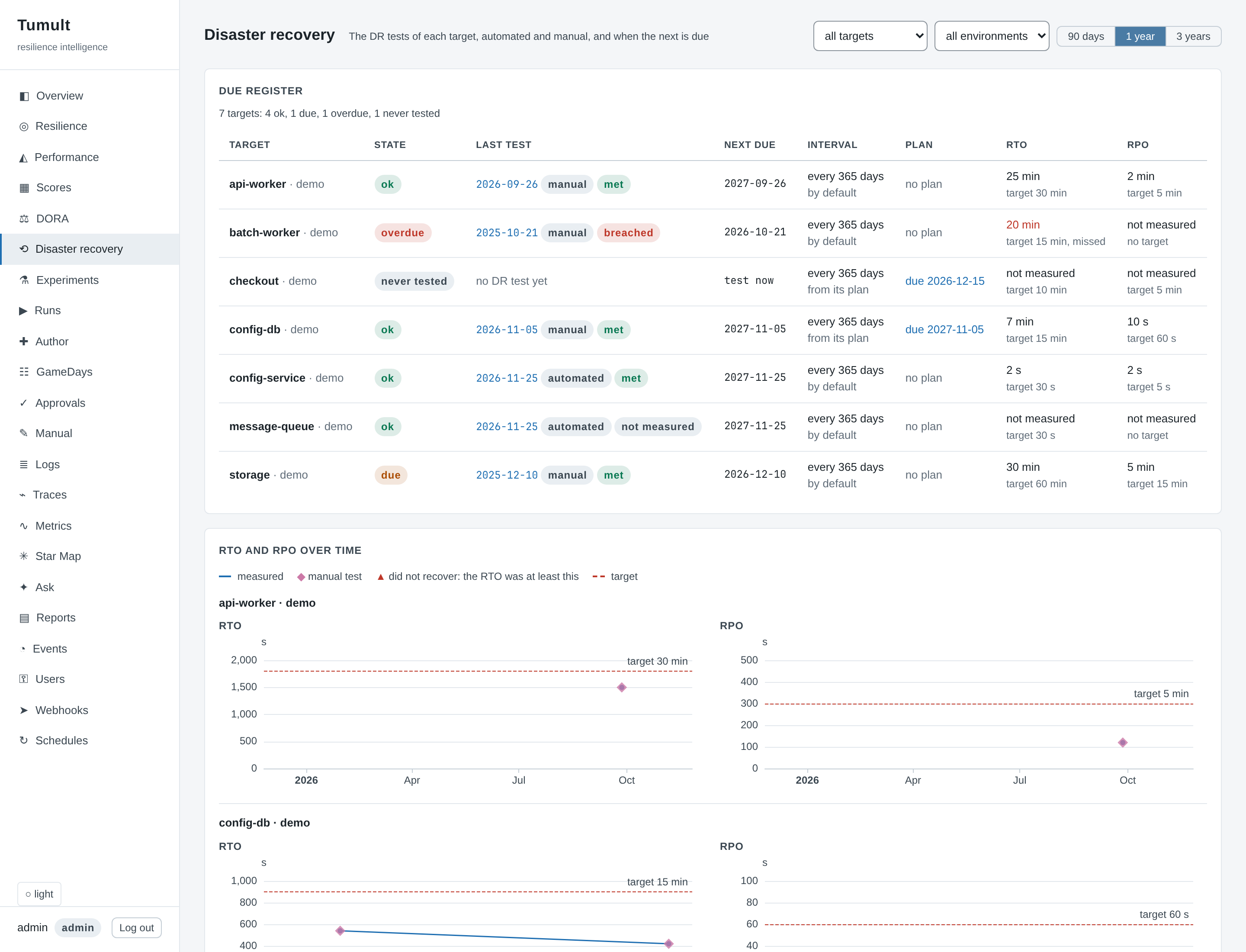
tumult manualor the MCP tools. An agent may draft a record; only a person signs it. - One DR page. The Disaster recovery page of Krönika shows the DR tests of each target, runs and records together, when the next test is due, and the RTO and RPO over time.
- Reports for an auditor. The DR test report of a target, the DR exercise report of one record, and an evidence pack built from the DORA requirement registry.
- Findings about recovery. The risk view flags a run that did not recover, a target with no measured recovery, data lost beyond the RPO and a DR test that is late.
- DORA counts real DR tests. A backup or restore row counts a run only when it ran a backup, restore or promote step. The DORA view shows which plan scenarios of RTS 2024/1774 each critical or important function has tested.
tumult trendfollows the RTO and the RPO of a target across runs.
Behaviour that changed
| What | Before | Now | What to do |
|---|---|---|---|
| DR run that does not come back in its window | RTO inconclusive | RTO breached: the run deviates, its rollbacks run and tumult run exits 1 | Make the window at least as long as the RTO |
| RTO of an outage inside the method | 0 s, met | Timed from the first read that saw it | Check your RTO targets |
| Fault that no probe saw | RTO 0 s, met | inconclusive, “no outage observed”, and no evidence of recovery | Make a probe see the fault |
mttr_s and rto_measured_s of a run with no outage | 0 | Empty (null), and left out of the MTTR of the overview and the reports | Handle null |
| JUnit of a run with a breached blocking objective | No failing case | A failing case for the objective | Expect the CI job to fail |
tumult validate on a misfit objective, such as rpo on fault.duration_s, or a ${...} that nothing fills | Passed | Refused | Fix the file, or pass --var |
Recovery share of a GameDay and of tumult compliance | Against the GameDay target or 30 s | Against the rto_target_s of each run | Set rto_target_s |
scoring.recovery_required: true | No effect | A step that measured no recovery is a failed recovery | Make the probe of each step see its fault |
| GameDay where no run measured a recovery | Recovery 1.00 | not measured, and the other three parts share its weight | None |
| Run that did not recover, in the risk view | objective_breached only | Also recovery_target_missed, and 0 for the recovery part of the resilience score | None |
| DORA Art. 11(6) switchover, Art. 12(2), Art. 16(1)(f) and RTS 2024/1774 Art. 40 | Any run of kind dr | Only a run with a backup, restore or promote-replica step | Add such a step, or record a manual restore test |
New DORA rows rts1774.art26 and rts1774.art39 | Not scored | A gap on each critical or important function until a test names its scenarios; a level 5 entity drops to 4 | Name the scenarios in regulatory.scenarios |
| Manual record or experiment file with a DORA id the registry does not know | Taken | Refused with the nearest id: 422, or an error of tumult validate | Use the registry id, such as dora.art24.6 |
| Unknown field in a manual API body | Dropped | 422 naming the field | Fix the client |
| Manual self review | 400 | 422 | Check for 422 |
Draft manual record on GET /api/experiments | Listed | Not listed | None |
| Independence in the R2 evidence pack | “Independence has not been verified” | “N of M tests name an external tester” | None |
checkout-spike-oha | performance, one oha process per stage | robustness, one per 2 s window | None |
Redis action simulate-failover | A hang with the name of a failover | A deprecated name of simulate-hang | Use simulate-hang |
| Lake schema | v21 | v26, and a 3.0.3 build refuses it | Back up first |
Upgrade
The lake moves from schema v21 to v26 by itself the first time 3.0.4 opens it. A 3.0.3 build refuses a v26 lake, so back it up first: stop the daemon and run tumult store backup --output <dir>.
The five steps are additive. Rows stored before keep the new columns empty.
- v22: a manual record holds a DR exercise: the RTO and RPO planned and actual, whether the data was verified, people, steps, actions, links, plans, sign-offs and files.
- v23:
probe_samples.reading, the number a probe printed. - v24: what a DR run measured:
impact_observed, the outage start, the recovery time andmttr_s, andrecoveredandreasonon a verdict. - v25: the view
dr_tests, one row per DR test. - v26: the plan scenarios of a run and of a manual record.
A manual record sealed before keeps its seal (hash_version 1) until its next edit, submit, verify or reject.
Before you upgrade, check these points.
- Run
tumult validateon your experiment files. - Give each DR test a recovery window at least as long as its RTO.
- Check pipelines that read a JUnit file or the exit code of
tumult run. - Check clients of the manual API: an unknown field is now 422.
Coming from 2.x? Read the 3.0.0 notes first.
Known limits
- k6 keeps no load windows, so the soak drift and spike recovery objectives are always inconclusive with k6. Use oha. A window in which nothing answered leaves no sample, so a drift does not see a blackout.
- The Reports page has no form for the DR test and DR exercise reports. Make them with
POST /api/reports/v2/generateortumultd report --template. - No page or route closes the action of a record yet. Track it by its ticket.
- A target that was never tested shows
never testedon the DR page, but raises no finding. POST /api/risks/{id}/recommendhas no experiment to offer forrpo_missed,recovery_not_measured,dr_test_overdueormanual_exercise_overdue.- The risk view knows no criticality of a target, so a finding on a critical target is not raised a step.
- The JUnit case of an RTO that did not recover says “observed N”, not that the target did not recover. A run that deviates only because its load missed its thresholds has no failing case.
- A run with no
--var, noconfigurationand nosecretsfills no${...}. In the arguments of a process step, it goes to the program as written. - A run counts for the DORA backup and restore rows only when the lake has its trace or its definition. A run read from its definition shows no rollbacks.
- The evidence pack counts external testers of manual records only. A run names its tester in its journal, which the lake does not keep.
- A run reported only over OTLP names no plan scenarios. A scenario is the word of the author; only
backup_restoreis checked against a step. - The RPO of
postgres-restore-rpoincludes the timepg_dumptakes, which grows with the orders table of the demo. - On the DORA view, the plan scenario table scrolls sideways at 1440 px, and the heatmap labels the RTS 2024/1774 rows “Art. rts1774”.
- The demo is docker only. Kubernetes DR and the DR of real cloud accounts are not proven by it.
More
Each change is in the changelog.