Logging
Every Tumult binary writes its diagnostics as structured events to stderr. This page shows how to read and configure them, and the rules for a Tumult developer who adds an event. Command results (tumult run output, reports, the MCP stream) go to stdout; logs never do.
flowchart TD
  accTitle: Where log events go
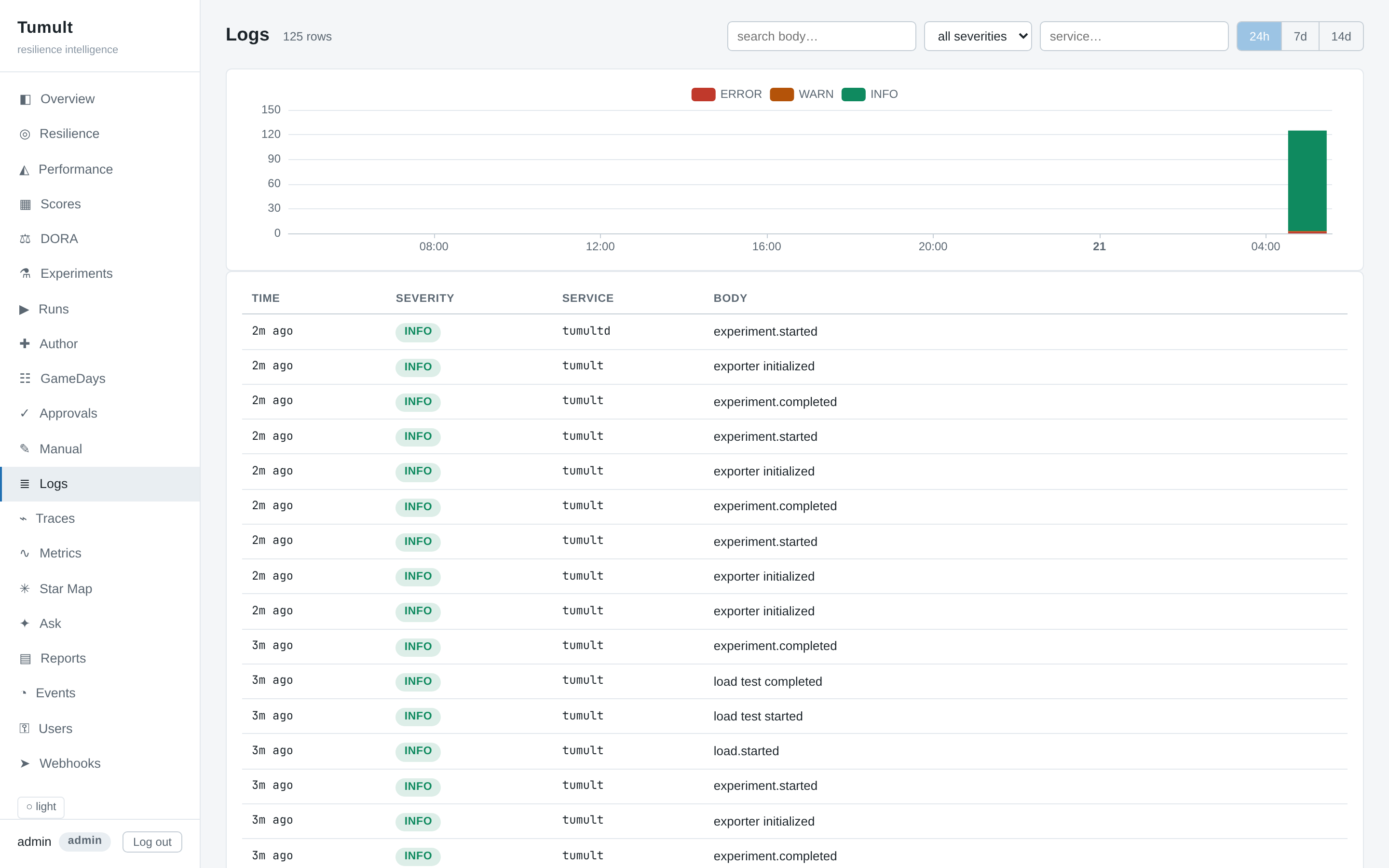
  accDescr: An event goes through one subscriber to stderr as JSON or text, and, when an OTLP endpoint is set, as OTLP log records to a Collector or to tumultd, which shows them on the Krönika Logs page.
  event["An event with a name, a message and fields"] --> sub["One subscriber:<br/>tumult_otel::logging::init"]
  sub --> stderr["stderr: one JSON line per event,<br/>or text on a terminal"]
  sub -->|"when an OTLP endpoint is set"| otlp["OTLP log records"]
  otlp --> collector["Your Collector, or tumultd itself"]
  collector --> page["Krönika Logs page"]
Read a log line
{"timestamp":"2026-11-13T09:14:02.118334Z","level":"WARN","target":"tumult_cli::commands::events","event.name":"cli.daemon.unreachable","message":"daemon unreachable, writing the store directly","service.name":"tumult","service.version":"3.0.2","url.full":"http://127.0.0.1:4318","error.message":"connection refused"}
| Key | Meaning |
|---|---|
timestamp | RFC 3339, UTC, microseconds |
level | TRACE, DEBUG, INFO, WARN or ERROR |
target | the Rust module of the event |
event.name | the stable name of the event; match alerts and tests on it |
message | a constant sentence |
service.name, service.version | the binary and its version |
deployment.environment.name | when it is configured |
trace_id, span_id | inside an OpenTelemetry span |
spans | the enclosing tracing spans, outermost first |
Every other key is a field of the event. A field that has one of the names above is written as field.<name>. One event is one line; control characters are escaped; numbers and booleans keep their JSON type. A string longer than 8 KiB is cut and ends with ...[truncated N bytes], the same on stderr and in OTLP. A closed stderr never stops the process.
Configure
| Variable | Effect |
|---|---|
RUST_LOG | The level filter (debug, info,tumult_ingest=debug). It replaces the default. A bad value logs logging.filter.invalid and keeps the default. |
TUMULT_LOG_FORMAT | json or text. Unset: text on a terminal, JSON otherwise. An unknown value gives JSON and logging.format.invalid. |
NO_COLOR | No colour in the text format. |
OTEL_RESOURCE_ATTRIBUTES | deployment.environment.name=... goes on every line. |
TUMULT_ENVIRONMENT | The environment when OTEL_RESOURCE_ATTRIBUTES sets none. |
OTEL_SERVICE_NAME | Replaces service.name (tumultd, or tumult for tumult and tumult-mcp). |
Without RUST_LOG, tumultd and tumult-net-proxyd log at info, and tumult and tumult-mcp at warn (info when an OTLP endpoint is set). The default filter caps the HTTP, gRPC, TLS and OpenTelemetry libraries at warn, and the exporter’s own events are never exported. tumultd exports to its own ingest, so the events of its ingest and store path stay on stderr only.
When a process ends badly
An error that ends a process is its last event: process.fatal, with error.message, and a non-zero exit code. A panic is process.panic with exception.message. Both reach stderr even when the filter hides them (then as one JSON line). If logging cannot start, the binary writes one logging.init.failed line and exits. The standard panic text and backtrace follow only when RUST_BACKTRACE is set and not 0.
Child processes and shutdown
tumult-net-proxydlogs JSON to a privatestderr.logfile while it runs, under$XDG_RUNTIME_DIRor the temp folder. The file stops at 1 MiB with onelogging.output.limit_reachedwarning, and is removed when the proxy stops.- Output of plugin scripts and agent CLIs is data, not log: it is captured and returned to the caller. A script’s output is cut at 8 MiB.
- A stopping
tumultdexports its last spans, metrics and logs and waits up to 15 seconds (daemon.telemetry.flush.timed_outafter that).
Event names and fields
An event name is lowercase and dotted, component.thing.happened, for example cli.journal.skipped. The first part is the component (daemon, auth, lake, cli, mcp, net, runs, …); the last says what happened (failed, skipped, rejected, timed_out). The message is constant; what varies goes in fields. Use the OpenTelemetry name where one exists:
| Field | Use |
|---|---|
error.message, error.type | the error (full chain) and a short class such as io or timeout |
exception.message | the payload of a caught panic |
resilience.experiment.id, resilience.experiment.name, resilience.run.id, resilience.outcome.status | control-plane ids, as on the spans |
user.name, client.address | the user and the peer of a request |
server.address, server.port, url.full, url.path | where a call goes; URLs are always sanitized |
http.request.method, http.response.status_code, http.response.body.size | HTTP calls |
file.path, config.key, config.value | a file, a setting, and its value (never a secret) |
process.pid, process.exit.code, process.executable.name, process.stream | child processes |
gen_ai.tool.name, db.namespace, signal, attempt, max_attempts | tools, databases, signals, retries |
*_ms, *_s, *_bytes | durations and sizes carry their unit |
For Tumult developers
Never log passwords, tokens, keys, cookies, Authorization headers, query strings, request or response bodies, prompts, model output, the output of child processes, or SQL and Cypher text. Log the name of a setting, a size, or a bounded class instead. Pass every URL through logging::sanitize_url, and an error text that may quote one through logging::redact_url; their rustdoc gives the exact rules.
Add an event test first. tumult_otel::logging::testing::capture_json runs a closure and returns what it logged (LogCapture in async tests):
let logs = capture_json(tracing::Level::WARN, || {
    journal_skipped(Path::new("a.toon"), &error);
});
assert_eq!(logs.named("cli.journal.skipped")[0]["file.path"], "a.toon");
Give the event a name, a constant message and fields from the table, then run python3 scripts/check-log-messages.py. It rejects old field names (error, path, run_id, …), span names that are not dotted, and an error.message built with format!. Pick ERROR when work was lost, WARN when a failure was handled or a setting is unsafe, INFO for lifecycle, DEBUG for detail. An error is returned or logged, never dropped.
Do not print. Clippy denies println!, eprintln! and dbg!; the few places whose output is the product of a command carry an #[allow] with a comment. tumult prints results with the outln!, out! and errln! macros of tumult_cli::output, which survive a closed pipe. The crates listed in DEFERRED in scripts/check-log-messages.py still log events without names.