Performance verdicts
A performance verdict answers one question per build: is this version of a service slower than the one before it? Tumult compares the latency samples of load runs against both versions and gives one of four answers: improved, unchanged, regressed or inconclusive.
One rule comes first: the verdict is never better than the evidence. Too little evidence is inconclusive, and that fails the gate by default.
See it in Krönika
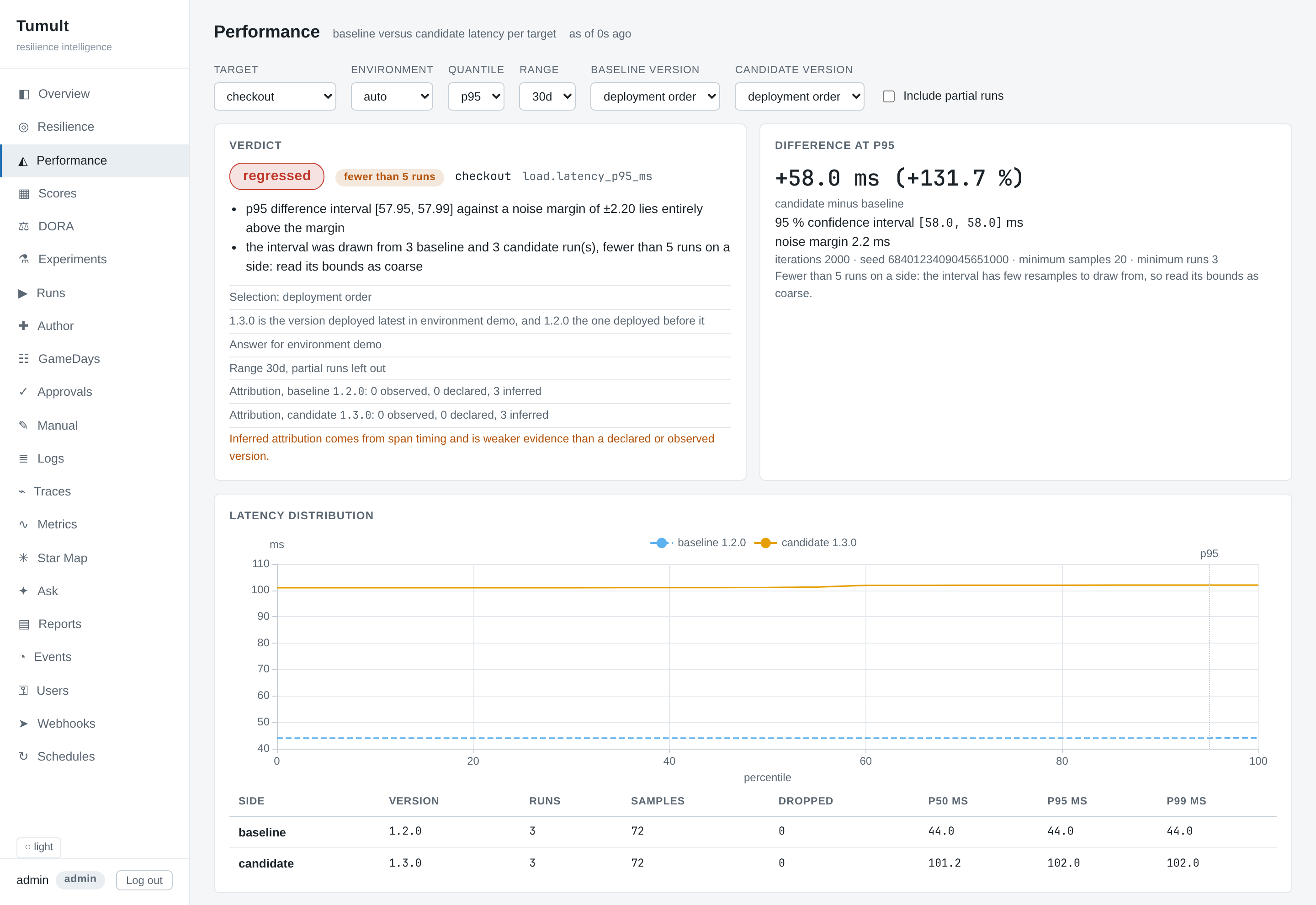
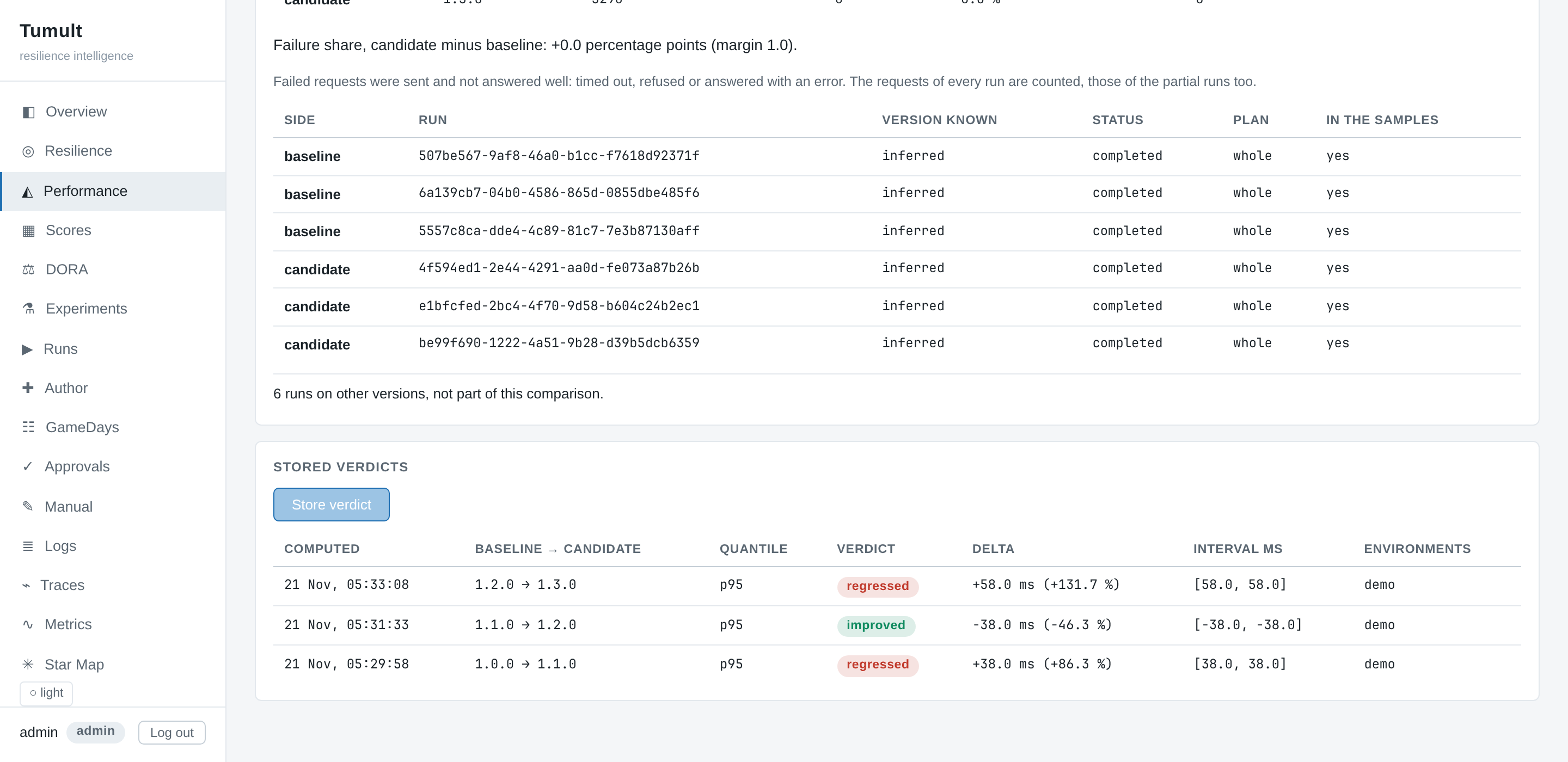
Open Performance and pick a target. The page shows the two versions, their runs and the verdict. Store verdict keeps it in the history.
How a verdict is made
- Find the version of each run. The best source is the version you declare:
tumult run soak.toon --target-version 1.5.0, ortarget.versionin the experiment. Without it, the run records the version that served at least 95 % of the target’s requests during the run. A run with no clear version takes no part, and the answer counts it inunattributed_runs. - Pick two versions in one environment. The candidate is the version deployed last, the baseline the one before it, unless you name them. A baseline from one environment is never compared with a candidate from another.
- Take the samples. By default the series is
load.latency_p95_ms, the p95 of each window that anohaload writes. A k6 run writes one summary only, so pointprobeat a series it has. - Check the requests first. A build that stops answering, or fails more requests than the baseline (by more than one percentage point and by more than chance, over enough requests), is
regressedwhatever its latency. - Compare the latency. Tumult draws a 95 % interval for the difference at p95 by resampling whole runs 2000 times, and compares it with a noise margin of 5 % of the baseline.
| Verdict | When |
|---|---|
regressed | The whole interval lies above the margin, or the requests failed |
improved | The whole interval lies below minus the margin |
unchanged | The interval is inside the margin, or covers zero and leaves the margin on one side at most |
inconclusive | Fewer than 3 runs or 20 samples on a side, one version only, or an interval too wide to tell |
Each side needs at least 3 runs. An interval from fewer than 5 runs is flagged as resting on few runs. reasons in the answer says in words why the verdict is what it is.
Gate a pipeline
export TUMULT_DAEMON_URL=http://tumultd.internal:4318
export TUMULT_DAEMON_TOKEN=kro_...   # viewer reads; --store needs operator
tumult perf checkout --env staging --candidate 1.5.0 --store
perf checkout: REGRESSED (p95 of load.latency_p95_ms)
  versions: the request named the pair in environment staging: the candidate is 1.5.0 and it is compared against 1.4.0
  baseline  1.4.0: 100.0 ms over 72 sample(s) in 5 run(s)
  candidate 1.5.0: 150.0 ms over 72 sample(s) in 5 run(s)
  delta +50.0 ms (+50.0%), CI [31.0, 70.0], margin ±5.0
  - p95 difference interval [31.00, 70.00] against a noise margin of ±5.00 lies entirely above the margin
  verdict stored in perf_verdicts
| Exit | Meaning |
|---|---|
0 | improved or unchanged |
1 | The command failed, for example the daemon could not be reached or --store did not store |
2 | Usage error |
3 | regressed |
4 | inconclusive |
--fail-on regressed lets inconclusive pass, and --fail-on never only prints. --json prints the daemon’s answer.
A pipeline that works:
flowchart TD
    accTitle: A performance gate in a pipeline
    accDescr: Deploy the build, run a soak with its version three times or more, then ask tumult perf for the verdict and fail the job on regressed or inconclusive.
    A[Deploy build N to staging] --> B["tumult run soak.toon --target-version N"]
    B --> C{Three runs or more?}
    C -- no --> B
    C -- yes --> D["tumult perf checkout --env staging --candidate N --store"]
    D --> E[Exit 0 passes, 3 or 4 fails the job]
Always pass --candidate: the pipeline knows which build it tests. The gate templates are in deploy/ci/.
Options
| Option | Default | Meaning |
|---|---|---|
--probe | load.latency_p95_ms | The sample series to compare |
--quantile | p95 | p50, p95 or p99 |
--margin-pct | 5 | Noise margin, percent of the baseline |
--min-runs | 3 | Fewest runs a side needs (1 to 1000) |
--min-samples | 20 | Fewest samples a side needs |
--baseline, --candidate | the two versions deployed last | The versions to compare |
--env | the only one that can answer | The environment |
--range | 30d | How far back runs and samples are read |
--include partial | off | Keep samples of aborted or cut short runs |
The same options are query parameters of GET /api/perf/{target} (Viewer role). POST /api/perf/{target}/verdicts (Operator role) also stores the verdict. A retry with the same evidence stores nothing new.
Next
- Load testing: write the soak that feeds the verdict.
- Forecasting: how far a run pushed a metric.