Kinds of testing
Tumult runs four kinds of resilience test. Each asks its own question. All four use the same experiment file, objectives, journal and lake. The kind of an experiment says which one it is.
| Kind | Question | Fault or stress | Measure | Typical cadence | In Tumult |
|---|---|---|---|---|---|
| Chaos | Does it stay healthy when one part fails? | Kill, pause, cut off or slow one part | Steady state before, during and after; time to recover | Often, on a timer; a GameDay each quarter | kind: chaos, schedules, GameDays |
| Robustness | Does it hold under stress, and come back? | Traffic past capacity, a spike, a long soak, CPU pressure, bad input | Availability under stress, p95 drift, recovery after a spike | Before a release, and after a capacity change | kind: robustness with a load section |
| Disaster recovery | Does it come back in time, with its data? | Lose the whole system or its data | RTO and RPO against their targets | Once a year or more often, per target | kind: dr, manual records, the DR page, DR reports |
| Load and performance | Is it fast enough, and is this build slower? | None, only traffic | Latency, throughput, error rate; build against build | Each build, in the pipeline | A load section, tumult perf |
A fifth kind, security, is not on this page.
Chaos engineering
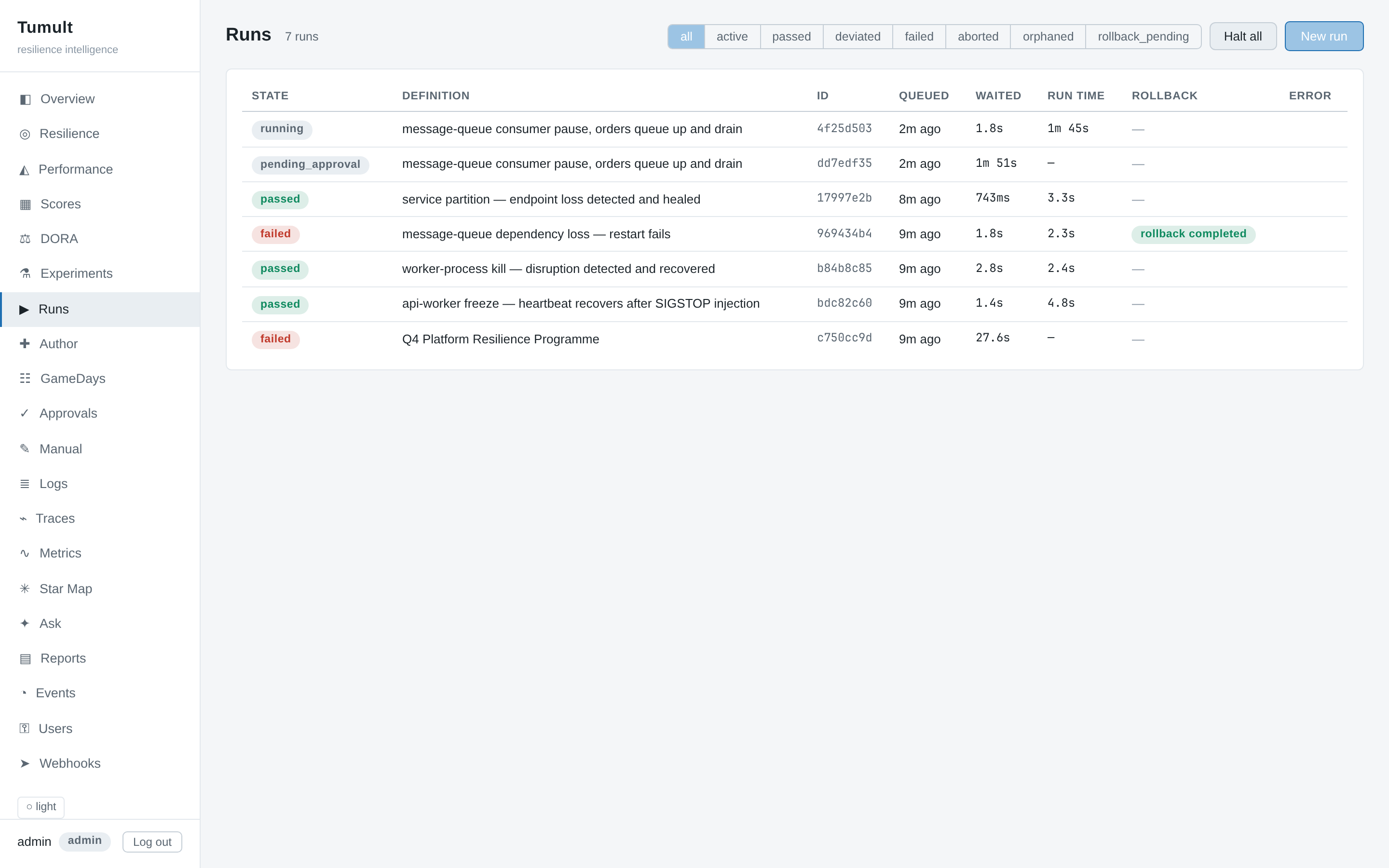
Does the system stay healthy when one part fails?
- Breaks: one part at a time. Kill a process, pause a container, cut the network or add latency.
- Measures: the steady state before, during and after the fault, and the time to recover. A guard stops the run when the system breaches.
- When: often and on a timer, so a change that breaks resilience shows soon. Group runs in a GameDay.
- In Tumult: an experiment of
kind: chaos, the default. Run it withtumult run, on a schedule, or in a GameDay. See Experiment format.
Robustness
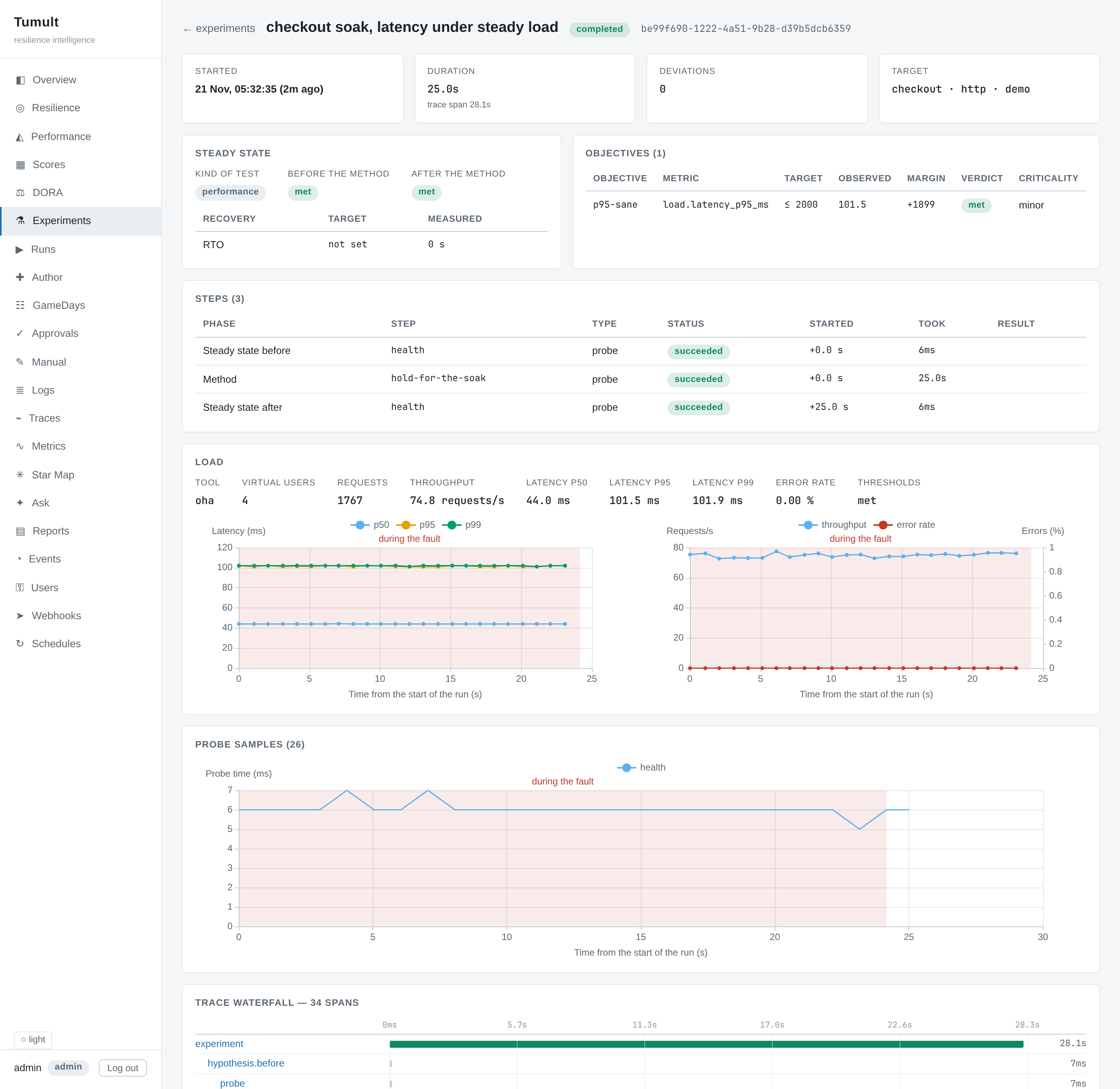
Does the system hold under stress, and come back after it?
- Stresses: traffic past its capacity, a sudden spike, hours of steady load, CPU pressure or malformed input.
- Measures: availability under the stress, how far the p95 and the error rate drift in a soak, and how fast the p95 comes back after a spike. The system may slow down. It must not fall over.
- When: before a release, and after a change of capacity.
- In Tumult: an experiment of
kind: robustnesswith aloadsection, such asexamples/api-saturation.toon. See Robustness under load.
Disaster recovery
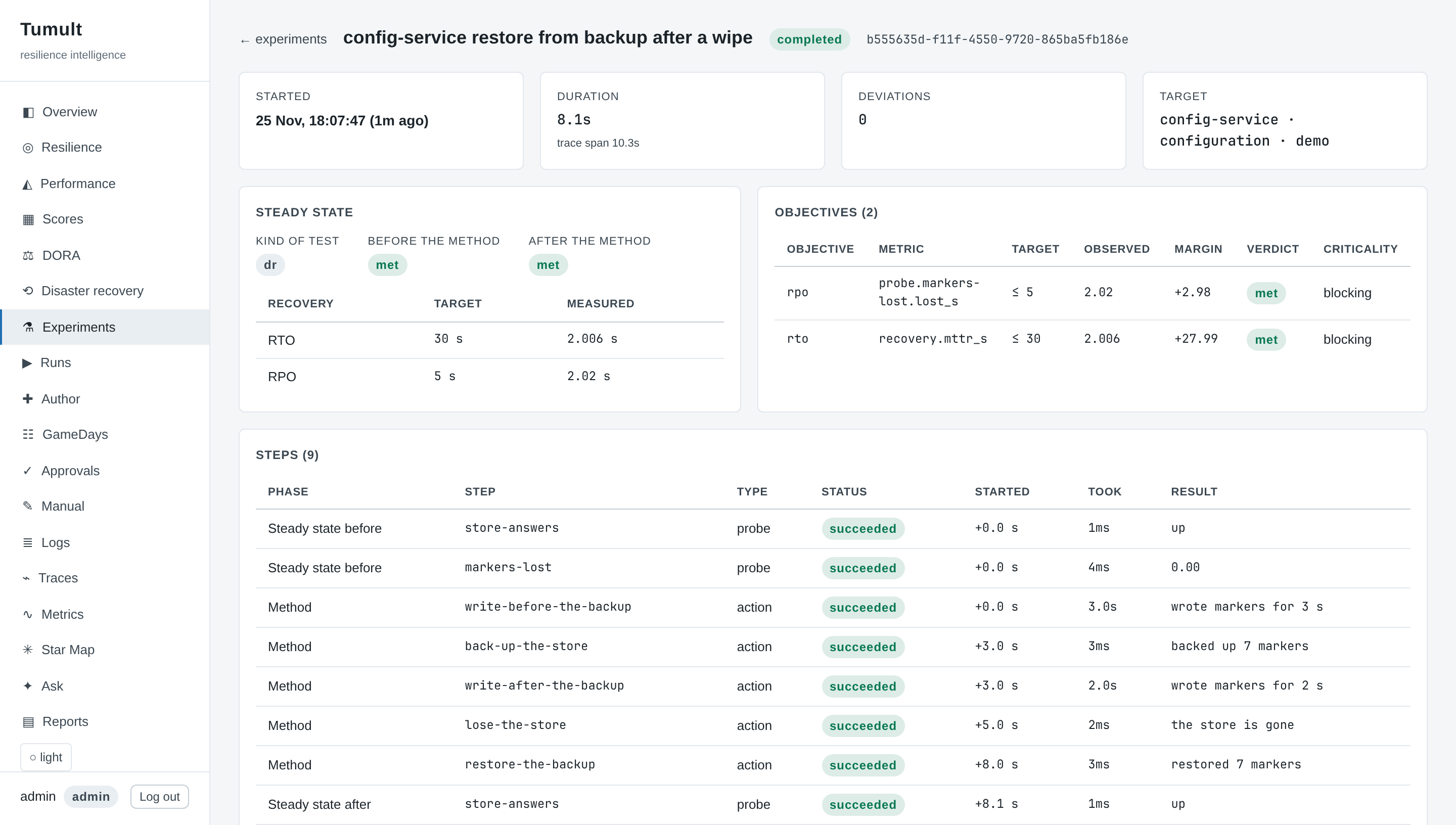
Does the system come back in time after you lose it, and with its data?
- Breaks: the whole system or its data. Stop the primary, lose a zone, wipe a store and restore it.
- Measures: the RTO, from the outage the probes saw to the read where they pass again, and the RPO, the seconds of data lost. Each against its target. A run that saw no outage is no evidence.
- When: once a year or more often, and after a change to the recovery path. The DR page says when each target is due.
- In Tumult: a run of
kind: drwithrto_target_s, or a manual record of a drill that people run. See Disaster recovery.
Load and performance
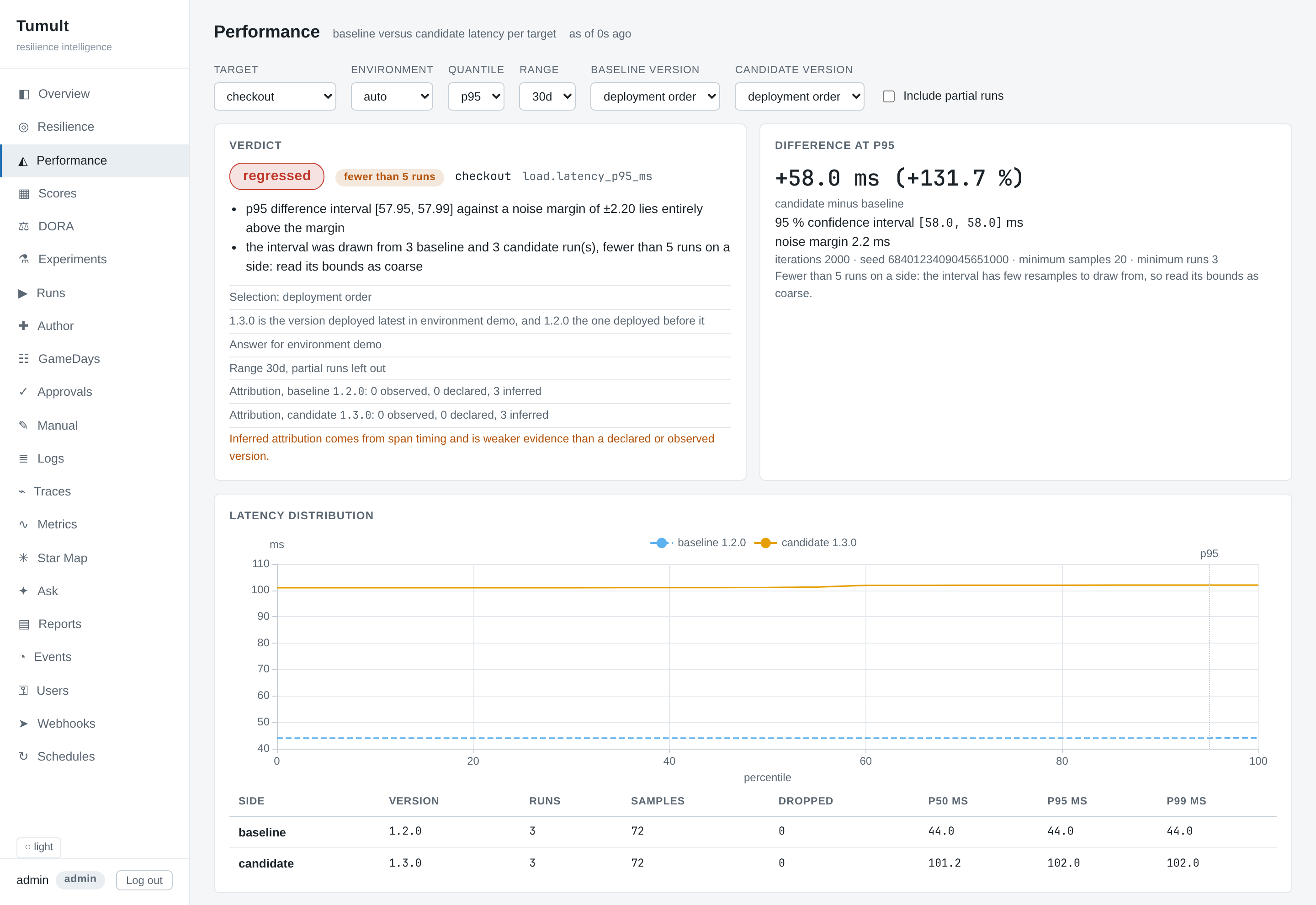
Is the system fast enough, and is the new build slower than the last?
- Stresses: nothing breaks. k6 or oha sends traffic in a ramp, a spike or a soak.
- Measures: latency (p50, p95, p99), throughput and error rate. Objectives judge each number. A performance verdict compares two builds:
improved,unchanged,regressedorinconclusive. - When: on each build, as a gate in the pipeline.
- In Tumult: a
loadsection, andtumult perffor the verdict. See Load testing and Performance verdicts.
What differs
The kinds differ in what they break and in what counts as a pass.
- Chaos passes when the steady state holds through the fault.
- Robustness passes when the system bends but does not fall.
- Disaster recovery passes when the RTO and the RPO are met.
- Load and performance passes when the numbers meet their objectives and the build is no slower than the last.
What overlaps
flowchart TD
  accTitle: What the kinds of testing share
  accDescr: Chaos, robustness and disaster recovery all put a fault or a stress on the system and time how long it takes to come back. Robustness and load and performance both send traffic with k6 or oha. Disaster recovery also measures the data lost, the RPO. Load and performance also compares one build with the last.
  dr["Disaster recovery"]
  chaos["Chaos"]
  robust["Robustness"]
  load["Load and performance"]
  dr --> rpo(["Data lost: the RPO"])
  dr --> fault(["A fault or a stress,<br/>and the time to recover"])
  chaos --> fault
  robust --> fault
  robust --> traffic(["Traffic from<br/>k6 or oha"])
  load --> traffic
  load --> build(["This build<br/>against the last"])
- Chaos, robustness and DR put a fault or a stress on the system and time how long it takes to come back.
- Robustness and load use the same
loadsection and the same traffic profiles. - For the scores, DR counts as robustness and
loadasperformance. The Resilience page shows the gaps of each target by kind.
Combine them
A load test with a fault. examples/pg-load-chaos.toon sends queries with k6 while Pumba pauses the PostgreSQL container. The journal keeps the load result next to the steps of the fault. Add an objective on load.error_rate to judge it.
kind: chaos
load:
  tool: k6
  script: examples/k6/pg-load.js
  vus: 5
  duration_s: 15.0
A DR test under load. Add load to a DR test from the command line. The load runs through the failover and the recovery check, so the RTO is measured while users still call. Make the method as long as the load, as When the load runs says.
tumult run examples/postgres-failover.toon --load oha \
  --load-script http://demo-app:8080/health --load-vus 20 --load-duration 30s
Next
- Regulations and standards: which kind of test gives evidence for DORA, NIS2 and five more frameworks.
- Objectives: every metric a run can judge.