Execution bindings
A binding says that one reviewed experiment, with its resolved inputs, may run in one environment and on one target. The daemon does not trust the env label of a request: without a binding a run is tier T3.
flowchart TD
  accTitle: How a binding sets the tier of a run
  accDescr: The daemon fingerprints the resolved run. Without a binding for that fingerprint, environment and target the run is tier T3, which the approval queue cannot release, and a scoped user is refused. With a binding the normal tier rules apply.
  req["Run request: definition, env, target"] --> fp["Fingerprint of the resolved run"]
  fp --> bound{"A binding with this<br/>fingerprint, env and target?"}
  bound -->|no| t3["Tier T3.<br/>A user with environment scopes is refused."]
  bound -->|yes| tier["Normal tier rules:<br/>probe only T0, production faults T3"]
  t3 --> queue["The approval queue cannot release it:<br/>add a binding, or use break-glass"]
What a binding changes
- Unbound: tier T3, also for a
devlabel or a run that says it only has probes. The approval queue cannot release T3: Approve answers422with"missing": "execution_binding". Add the binding, reject the request and start the run again, or use break-glass. - Bound: the normal tier rules apply. A probe-only plan can be T0; faults in production stay T3, and the other risk rules still count. A request for another environment or target than its binding is refused.
- Users with environment scopes cannot start an unbound run at all.
- Schedules and GameDays follow the same rules. A scheduled run keeps the identity of its author, and each fire checks again that the author is enabled, is still an operator and may use the environment.
Add a binding
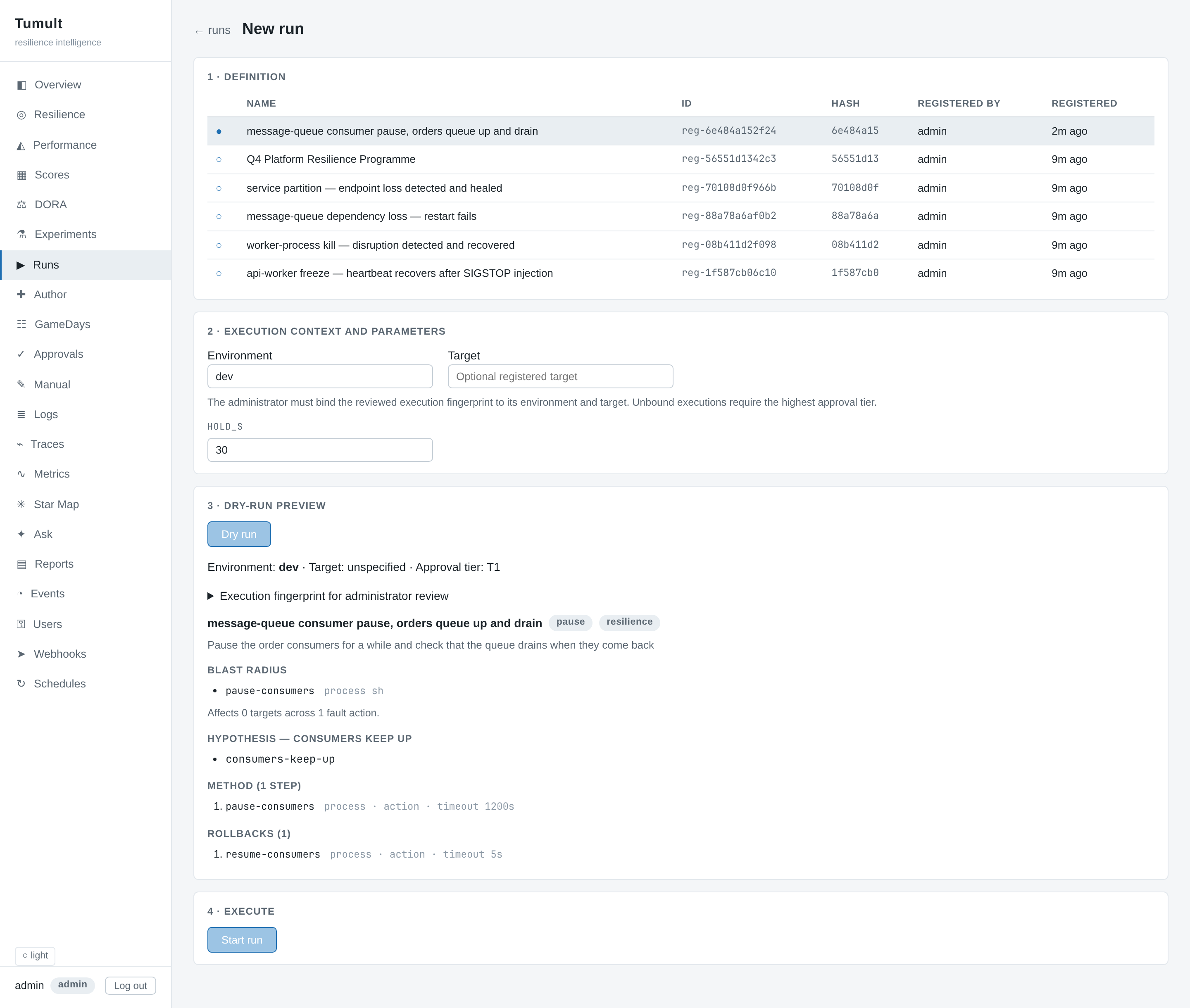
- Register the experiment, then open Runs, New run. Pick the environment and target, fill in the parameters and run a dry run. The preview masks configuration and secret values.
- Review the definition and where its connections, configuration and secrets come from. Open Execution fingerprint for administrator review to copy its SHA-256. Only an admin without environment scopes sees it (the
binding_hashfield of the dry-run answer). -
Add the fingerprint, the environment and the target to the bindings file.
targetisnullwhen no target is picked; it must match the request exactly.[ { "sha256": "<binding_hash from the reviewed dry run>", "env": "staging", "target": "database-a" } ] - Replace the file in one step (write a new file, then rename it). Only the admin may write it; the daemon must read it.
The Krönika demo binds its GameDay experiments the same way: demo/kronika/gamedays/seed-gameday.sh.
Where the file is
TUMULTD_EXECUTION_BINDINGS names the file. Without it the daemon reads the file next to the database: /var/lib/tumult/lake.duckdb uses /var/lib/tumult/lake.execution-bindings.json. A missing default file means no bindings. A file that cannot be read or parsed, or a named file that is missing, makes the daemon refuse runs until you fix it.
Keep it safe
- The fingerprint covers the resolved experiment and every injected configuration and secret value. A change to a parameter, a destination or a secret needs a new review and a new binding.
- Treat the fingerprint as a secret: with the rest of the run known, it can help guess a weak secret value. Do not publish binding files.
- Other clients get only an
execution_hashpreview token. Send it back unchanged with the run request. It stops working when the daemon restarts; run the dry run again. - A binding does not sandbox a script, freeze a remote service or prove who a target is. Control the scripts, credentials and network yourself, and run with as few privileges as you can.