Runs, approvals and roles
The daemon runs experiments itself. Each run gets a risk tier, may wait for a second person, and leaves an audit trail that shows any change. This page says how.
flowchart TD
    accTitle: The life of a daemon run
    accDescr: A definition is checked and registered. A run request gets a risk tier. A T0 run goes to the queue. A T1, T2 or T3 run waits for approval first. A worker checks the pin again and runs the experiment. Every step goes into the audit trail.
    reg[Check and register] --> ask[Ask for a run]
    ask --> tier{Risk tier}
    tier -->|T0| queue[Queue]
    tier -->|T1 to T3| wait[Wait for approval]
    wait -->|approved| queue
    queue --> pin[Check the pin again]
    pin --> run[Run, with rollbacks]
    run --> audit[(Audit trail)]
A run, step by step
- Register.
POST /api/runs/validatechecks a definition as the CLI does, and stores it once in the registry. - Dry run.
POST /api/runs/dry-runshows the steps with every value filled in. - Ask.
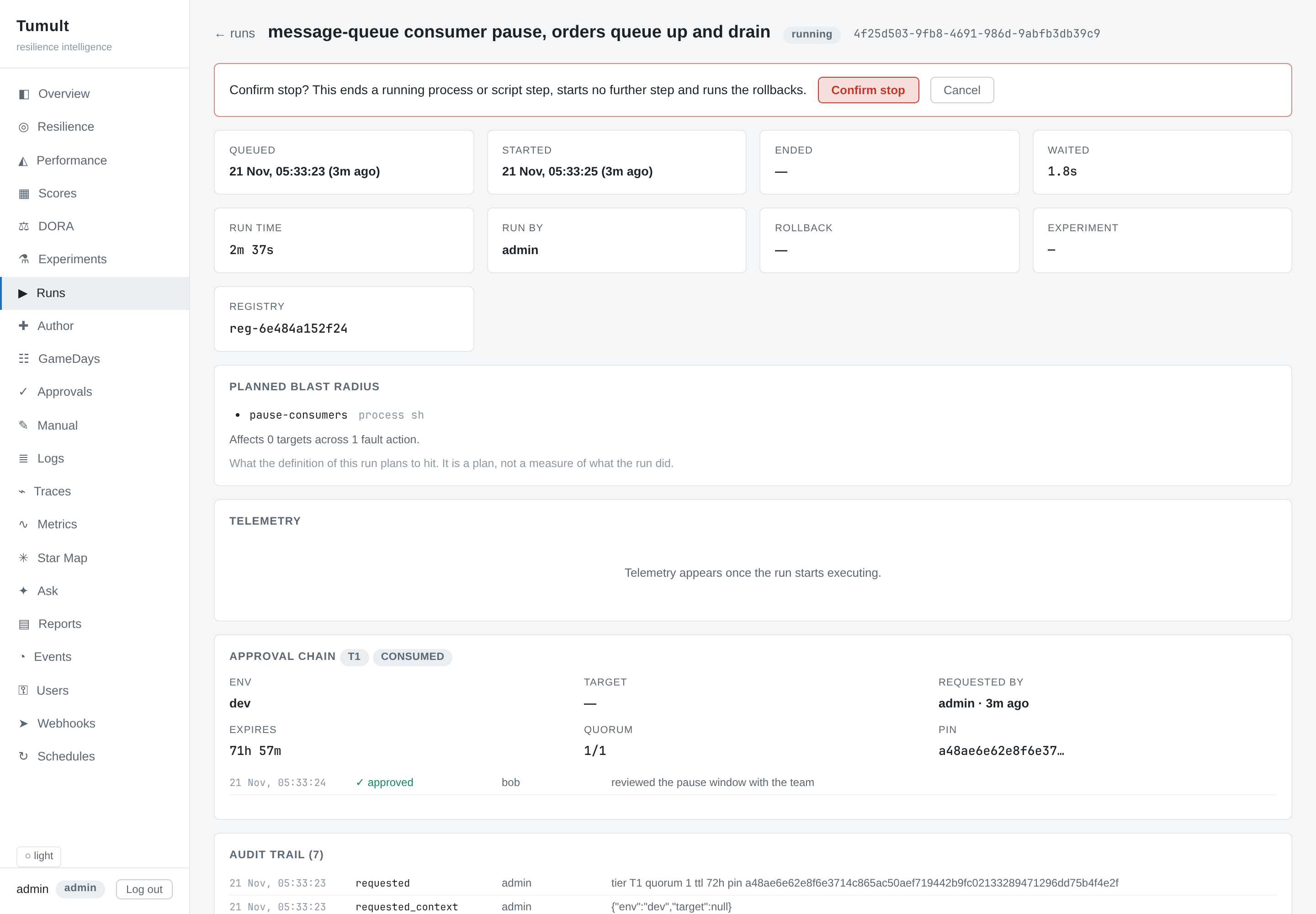
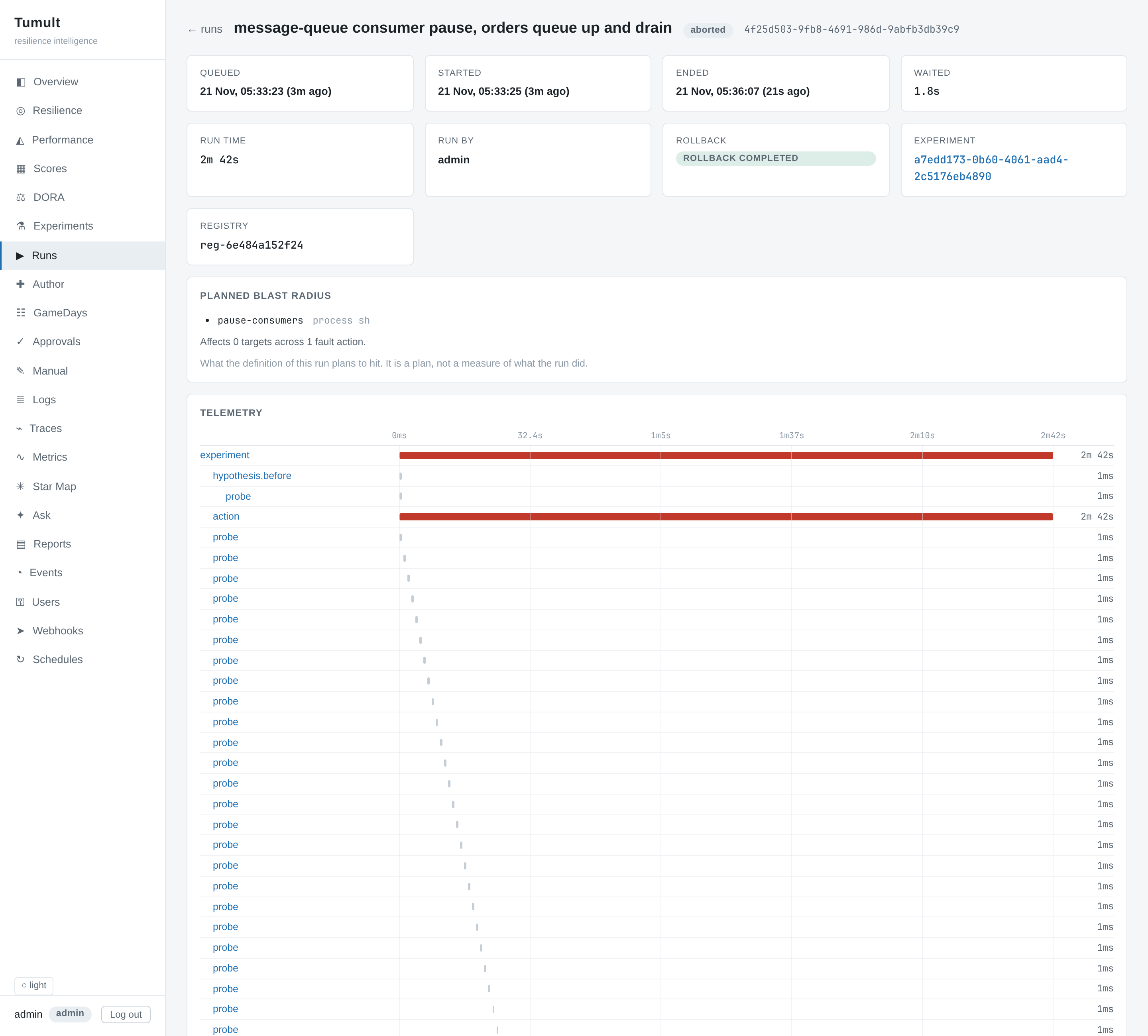
POST /api/runsgives the run a risk tier. A T0 run goes to the queue; any other run waits for approval. - Run. A worker runs the experiment with the same code as the CLI. The telemetry of the run goes to the daemon’s own ingest, so it shows like a run from the CLI.
- Stop.
POST /api/runs/{id}/stopstops the run, and its rollbacks run.
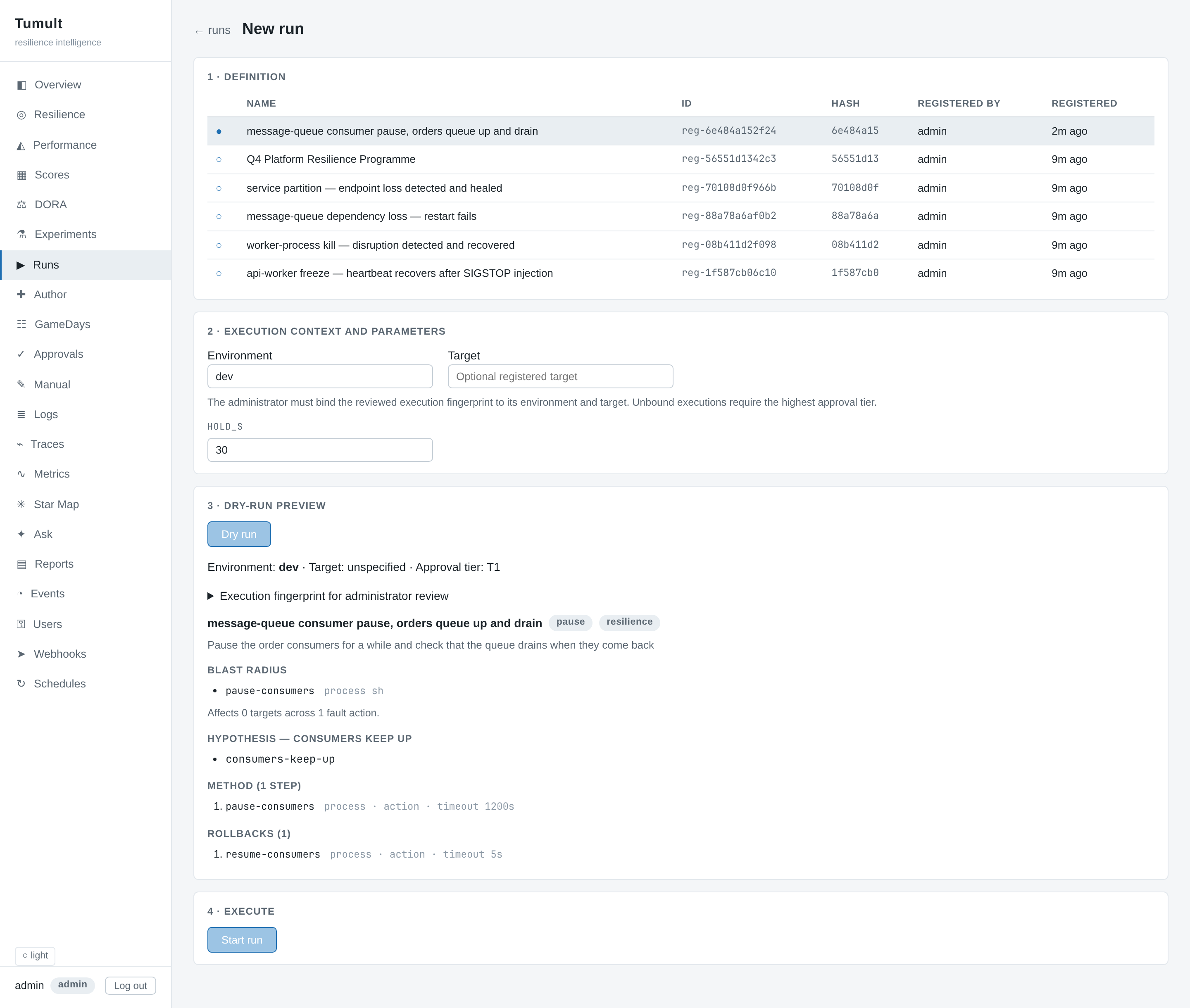
The queue runs 2 runs at a time and holds 32 more (TUMULTD_RUN_CONCURRENCY, TUMULTD_RUN_QUEUE_DEPTH). When it is full, a new run gets HTTP 429.
When the daemon starts, a run that was still active is marked orphaned, and its rollbacks run again. If one fails, the run shows rollback_pending for an operator to check.
Risk tiers
The highest rule that matches sets the tier.
| Tier | When | Approvers | Approval ends after |
|---|---|---|---|
| T0 | The run only reads: no action in it. | none | |
| T1 | Any other run. | 1 | 72 hours |
| T2 | A staging environment, or a fault with a destructive name. | 1 | 24 hours |
| T3 | A production environment, a fault without a rollback, more than one kind of fault, or no execution binding. | 2 | 4 hours |
- Nobody can approve their own run, and each approver decides once.
- An approval is used once. It pins a SHA-256 of the definition, its values, the environment and the target. Just before the run starts, the worker checks the pin again and refuses the run when anything changed.
- A T3 approval also asks the autopilot policy (
KRONIKA_AUTOPILOT_POLICY). Without a policy, or when the policy says no, the approval is refused. - Break-glass lets an admin start a run without the approvals. It needs a reason, still checks the pin, and opens a manual evidence record to fill in afterwards.
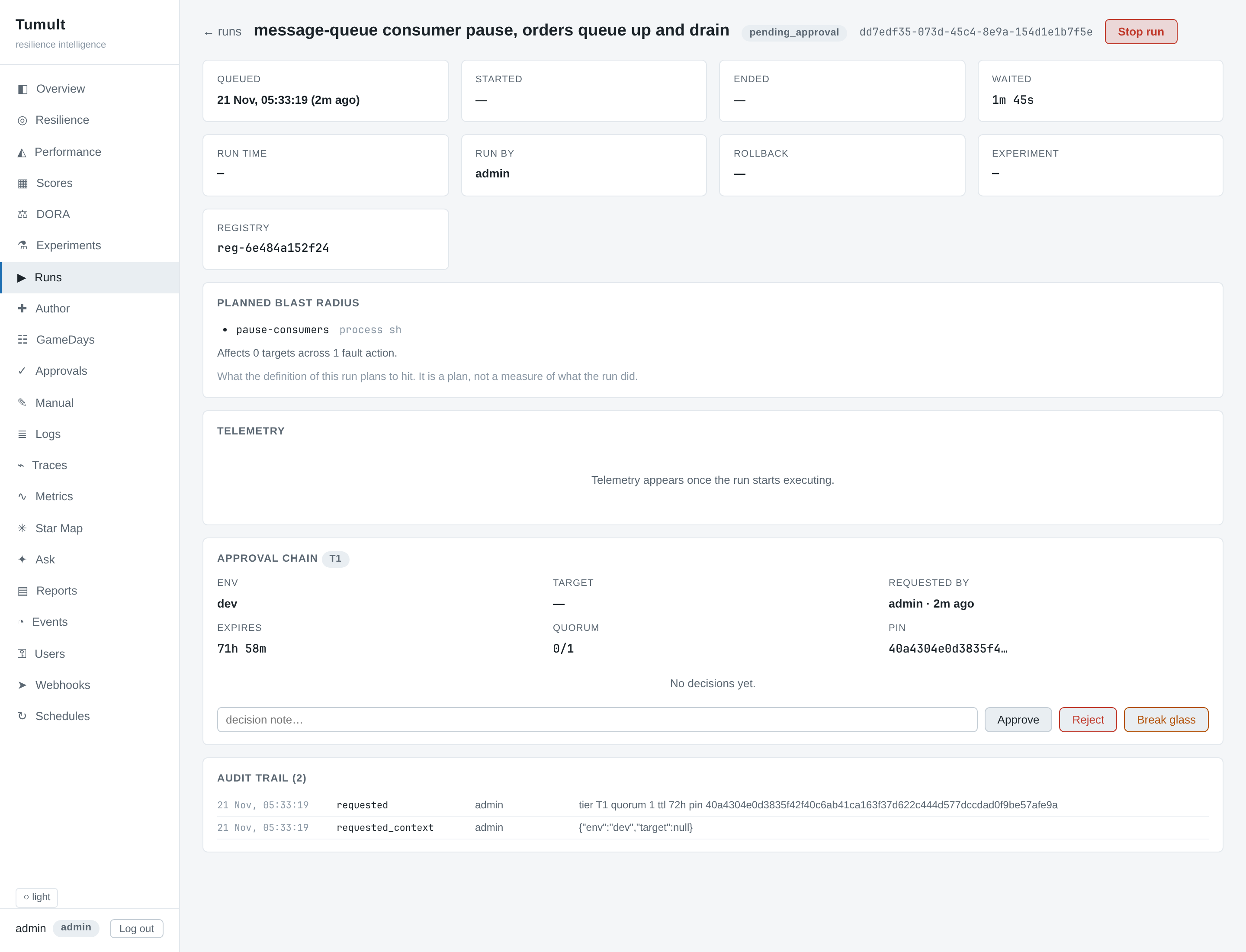
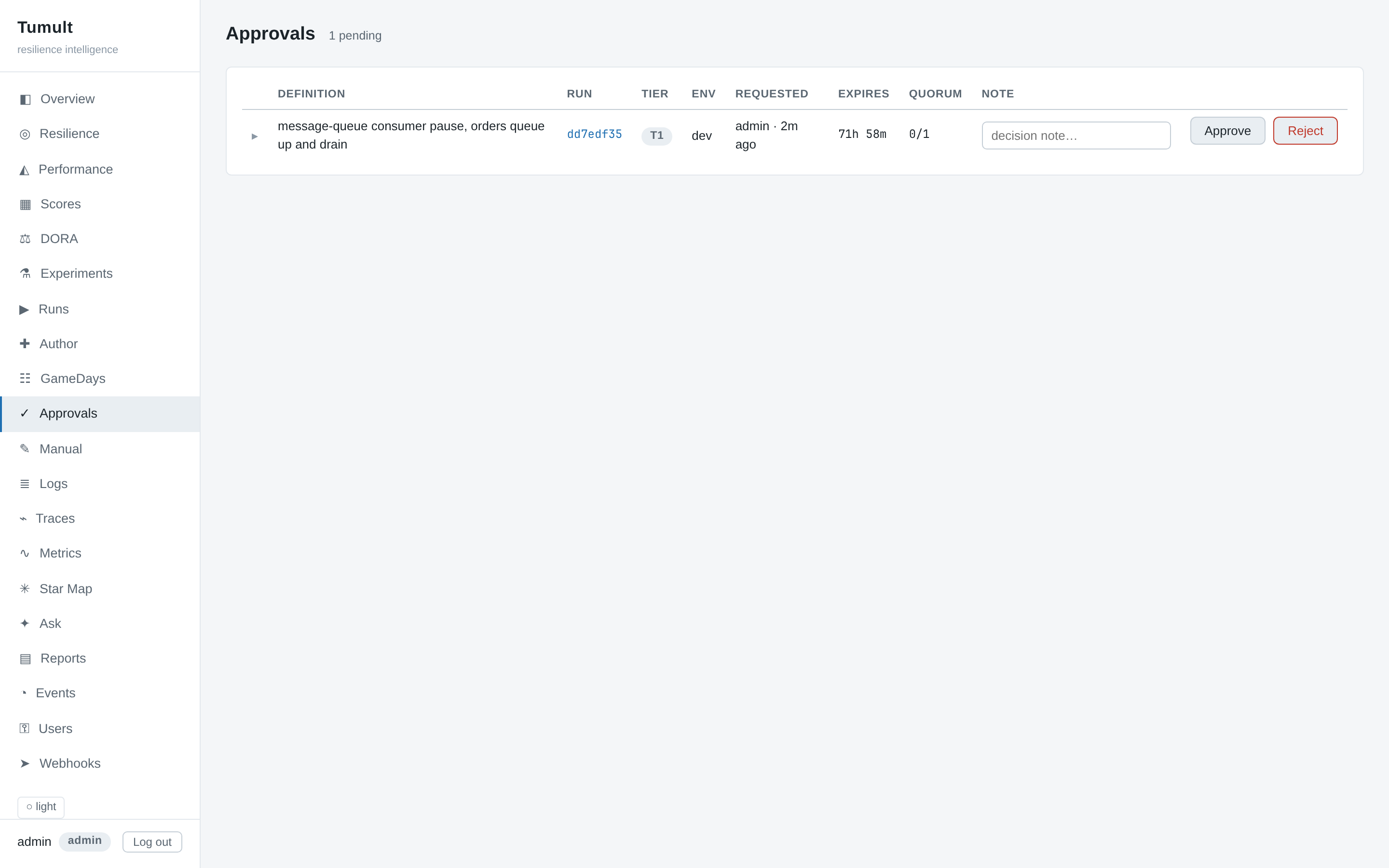
Each change of a run goes into run_audit with the user who made it, in a hash chain. GET /api/runs/{id}/audit/verify checks the chain.
Roles and sign-in
The API asks for a login once the first user exists.
| Role | May |
|---|---|
viewer | Read the evidence, the runs and the reports. |
operator | Also register, start, stop and schedule runs, and enter manual records. |
approver | Also approve or reject runs, and verify manual records. |
admin | Also manage users, tokens and webhooks, and use break-glass. |
tumultd create-adminmakes the first admin, with a one-time password that must be changed at the first login.- A browser session lasts 12 hours. Scripts use API tokens that start with
kro_. Passwords are hashed with argon2id; sessions and tokens are stored only as hashes. - An admin can limit a user to some environments.
- A route that is missing from the route table needs
admin. - On an address other than localhost, the daemon does not start without sign-in, and it needs
KRONIKA_INGEST_TOKENfor telemetry.
More for a real install: production deployment.