Disaster recovery
A disaster recovery (DR) test shows that a system comes back after you lose it. It must come back within its RTO, the time it may be down, and lose no more data than its RPO allows. A robustness test shows that a system holds under stress. For the scores, DR counts as robustness. The DR page and the findings show DR on its own.
flowchart LR
  accTitle: How Tumult tests disaster recovery
  accDescr: You plan a DR test with a due date. A run of kind dr, or an exercise people run by hand, tests the target. Each test measures the RTO and the RPO against their targets. The DR page shows when each target was tested and when the next test is due, the risk scan raises findings, and the reports give an auditor the evidence.
  plan["Plan a test<br/>with a due date"] --> run["A run of kind dr"]
  plan --> manual["An exercise<br/>run by hand"]
  run --> measure["RTO and RPO<br/>against their targets"]
  manual --> measure
  measure --> page["DR page<br/>and findings"]
  measure --> report["Reports<br/>for an auditor"]
Write a DR test
A DR test is an experiment of kind: dr. It must set rto_target_s. The method takes the system down and brings it back, for example with the PostgreSQL steps stop-primary, promote-replica, backup and restore. The steady-state probes say when the system is back.
kind: dr
target:
  system: config-service
  environment: demo
rto_target_s: 30
rpo_target_s: 5
recovery:
  window_s: 40
  interval_s: 1
The run page shows the RTO and the RPO the run measured, against their targets.
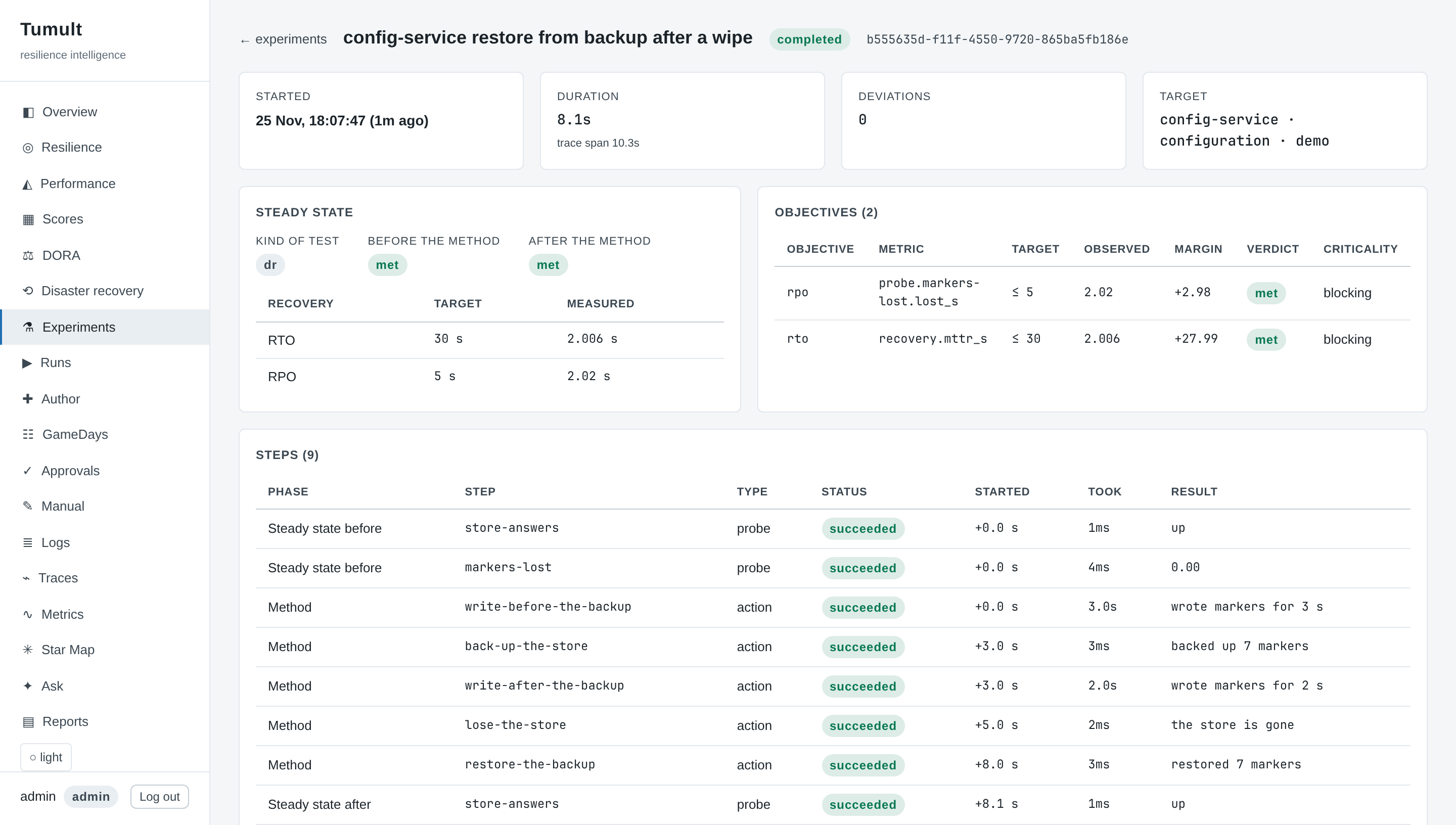
All fields are in the experiment format and in Objectives.
The RTO starts at the outage
The RTO clock starts at the first read of a steady-state probe that fails after the method started. It stops at the first read that passes after the last failure. After the method, the run reads the probes every interval_s seconds, for at most window_s seconds (by default 1 and 30). tumult run --recovery-window 90 sets the window for one run.
flowchart LR
  accTitle: The RTO clock of a DR run
  accDescr: The method injects the fault. When a probe read fails, the clock starts. The run reads the probes until they pass, and the clock stops. When the window ends first, the run did not recover and breaches its RTO. When no read fails, the run saw no outage and its RTO is inconclusive.
  fault["The method<br/>injects the fault"] --> fail["A read fails:<br/>the clock starts"]
  fail --> back["A read passes:<br/>the clock stops, RTO met or breached"]
  fail --> late["The window ends:<br/>not recovered, RTO breached"]
  fault --> none["No read fails:<br/>no outage observed, inconclusive"]
- A run that does not come back breaches its RTO. The verdict says
recovered: falseand gives the time it watched as the least the RTO was. - A run whose probes never failed saw no outage. It is no evidence of recovery.
- Make the window at least as long as the RTO.
tumult validatewarns when it is shorter.
The RPO comes from markers
The RPO of a run is the seconds of written data it lost. A step writes markers before the fault and notes each one in a ledger outside the store. A probe reads them back after the recovery.
sequenceDiagram
  accTitle: How a DR run measures the RPO
  accDescr: A writer step writes markers to the store and to a ledger. The store is backed up, and the writer goes on. The store is lost and restored from the backup. The reader probe prints the newest time in the ledger minus the newest marker left in the store. That is the RPO.
  participant writer as Writer step
  participant store as Store under test
  participant ledger as Ledger
  participant reader as Reader probe
  writer->>store: markers
  writer->>ledger: the same times
  Note over store: backup, then more markers
  Note over store: the store is lost and restored
  reader->>store: newest marker left
  reader->>ledger: newest time
  Note over reader: newest time minus newest marker: the RPO
The reader has the tolerance number, and an rpo objective reads probe.<reader>.lost_s. See Measure the RPO. The demo runs one for real: examples/postgres-restore-rpo.toon restores a backup that misses the last seconds of writes, see the RPO example.
Robustness under load
Two load profiles of oha judge robustness. A soak checks that the p95 and the error rate do not drift. A spike checks that the p95 comes back after the peak.
%%{init: {"themeVariables": {"xyChart": {"plotColorPalette": "#1f2a44"}}}}%%
xychart-beta
    accTitle: A spike and the recovery after it
    accDescr: The p95 of ten windows is about 100 ms before the spike, rises to about 400 ms during it, and is back below 120 ms, 1.2 times the p95 before, three windows after the spike ends.
    title "p95 per window: back within 1.2 times the p95 before the spike"
    x-axis ["1", "2", "3", "4 spike", "5 spike", "6", "7", "8", "9", "10"]
    y-axis "p95 (ms)" 0 --> 450
    bar [100, 98, 102, 380, 410, 260, 150, 115, 104, 101]
nfr[2]:
  - id: p95-drift
    kind: latency
    metric: load.p95_drift_pct
    operator: lte
    threshold: 20
  - id: back-after-spike
    kind: recovery
    metric: load.spike_recovery_s
    operator: lte
    threshold: 10
load.p95_drift_pct and load.error_rate_drift need a soak, and load.spike_recovery_s a spike with sample_interval_s. See Judge a soak or a spike.
Exercises run by hand
A restore test, a failover drill or a tabletop that people run is a manual record. Open Manual in Krönika, or use tumult manual from a terminal.
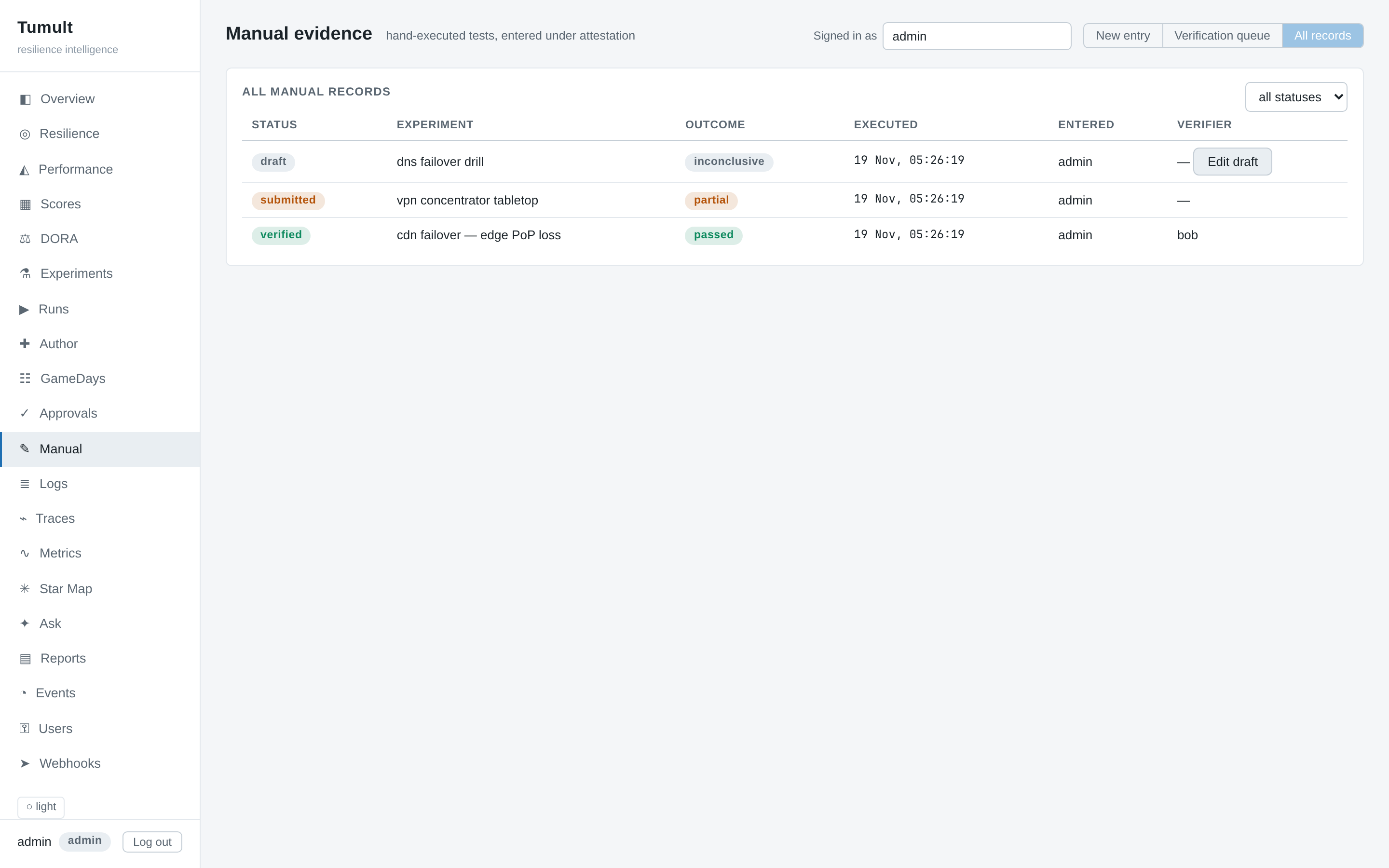
- Plan the exercise with an owner and a due date. A DR plan comes back every 365 days, unless you set an interval.
- Record it: the RTO and the RPO planned and actual, whether the data was checked, the people, the steps and the actions with their owners.
- Attach files as evidence, such as a runbook log. Tumult keeps each file by its SHA-256.
- Sign off. Another user approves the record. The house can ask for more than one sign-off per exercise type.
- Verify the audit trail at any time. It finds a changed, moved or deleted row.
The steps are in Manual of the Krönika pages. An agent over MCP may draft a record. Only a person submits and signs it.
The DR page
The Disaster recovery page (/dr) shows the DR tests of each target, runs and manual records together. The due register says when each target needs its next test.
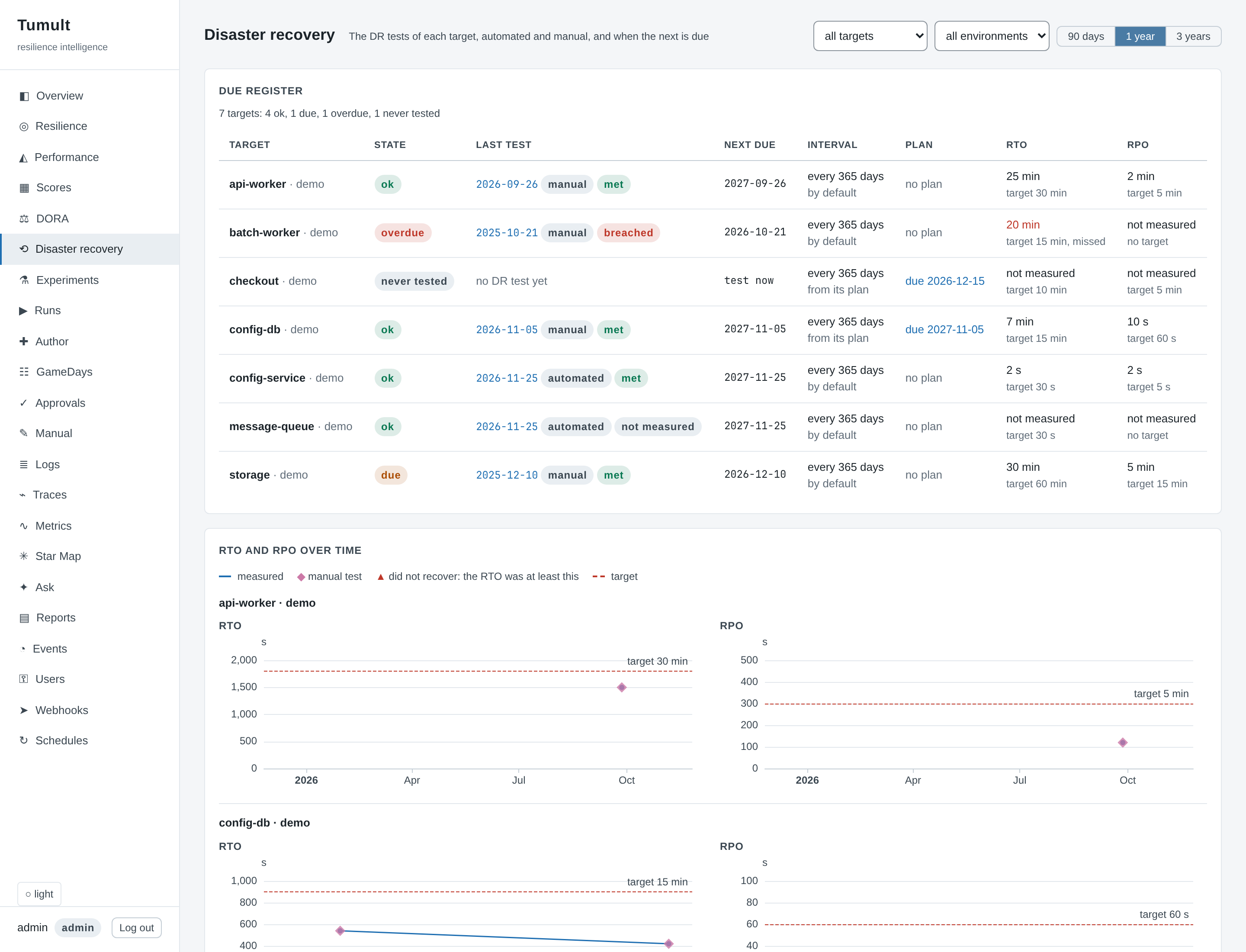
| State | When |
|---|---|
ok | The next test is due in more than 30 days |
due | The next test is due within 30 days |
overdue | The next test is past its due date |
never tested | The target declares an RTO or has a DR plan, and has no DR test yet |
A run that saw no outage is no DR test here. The interval comes from a planned DR exercise of the target, else from the DR test plan of its function, else it is 365 days. The risk scan reads the same facts: see Findings about recovery. In SQL, read the view dr_tests.
Reports for an auditor
Three reports give an auditor the DR evidence. Make them with POST /api/reports/v2/generate, or with tumultd report while the daemon is stopped.
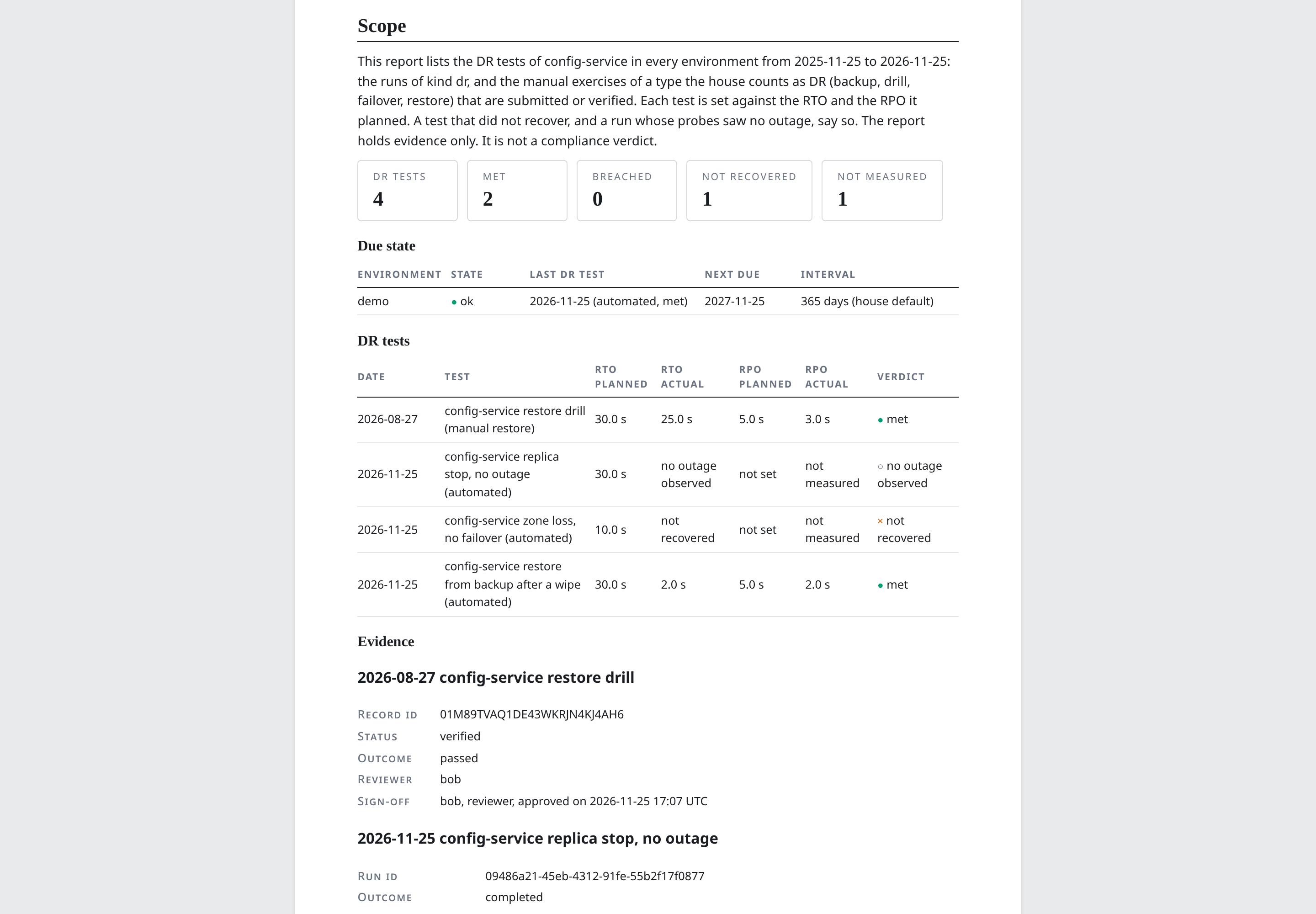
| Report | What it holds | Request |
|---|---|---|
| R4, DR test report | The DR tests of one target over a period, each against its RTO and RPO, with its evidence | {"type": "dr-test", "target": "config-service"} |
| R5, DR exercise report | One manual DR exercise: plan, people, steps, RTO and RPO, actions, files, sign-offs and the audit verify | {"type": "dr-exercise", "record_id": "<id>"} |
| R2, evidence pack | The DORA matrix from the requirement registry, the tests with their RTO and RPO, and how many name an external tester | {"type": "evidence-pack", "framework": "dora"} |
tumultd report --template dr-test --target config-service --out config-service.pdf
Each report states the SHA-256 of its PDF. More in Reports.
Plan scenarios of RTS 2024/1774
The DORA ICT risk RTS (Delegated Regulation (EU) 2024/1774) names the scenarios that continuity plans must be tested against, such as a cyber attack or a power outage. Name the scenarios a test covers: a run in regulatory.scenarios, a manual record in scenarios.
regulatory:
  frameworks[1]: DORA
  requirements[1]:
    - id: rts1774.art39
      description: The plan tested against a cyber attack
      evidence: The journal of the run
  scenarios[1]: cyber_attack
The DORA view shows, for each critical or important function, which scenarios passed, failed, are overdue or were never tested.
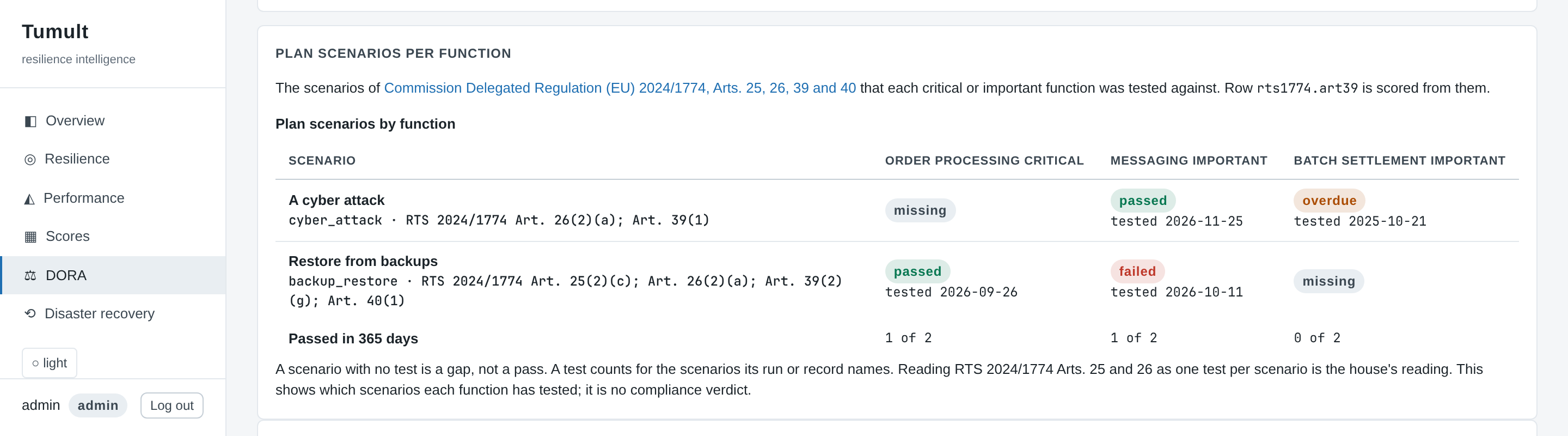
A run counts for backup_restore only when it ran a backup or restore step. The ids and the rows they count for are in Plan scenarios. The view shows what was tested. It does not say that a plan complies.
Next
- Objectives: every metric and verdict of a run.
- tumult-db: the PostgreSQL steps for backup, restore and failover.
- DORA score: how DR tests count for DORA.